Visit Mamaway Store
Saturday, July 6, 2013
Countdown to August
Thursday, January 31, 2013
Pearls from the Compostela Valley Breastfeeding Mission Experience - Part 3
This is the last of three parts. Please refer to Parts 1 and 2. This is a guest post written by Dr. Lei who participated in all the aspects of the breastfeeding mission. Dr. Lei also runs an online store, Caleb's Closet and shares her thoughts in her blog, Lei's Anatomy.
========================
4. Human Milk transport and storage requires a lot of logistics but tapping on to the right network, we have available resources to make things work.
Breast milk is a precious commodity that requires care in handling. Refrigerated human milk is good for 3-4 days. In the usual one-door domestic freezers, this extends to 3 weeks. For deep freezers, viability stretches from 6 months to 1 year. However, when frozen breast milk is thawed, it should be refrigerated, consumed or discarded within 24 hours.
Monday, January 28, 2013
Pearls from the Compostela Valley Breastfeeding Mission Experience - Part 2
This is the second of three parts. You can read Part 1 here. This is a guest post written by Dr. Lei who participated in all the aspects of the breastfeeding mission. Dr. Lei also runs an online store, Caleb's Closet and shares her thoughts in her blog, Lei's Anatomy.
=============================
3. Substantial amounts of human milk can be collected and stored for the above babies.
We were able to collect 67 liters of milk in less than 2 weeks. (Having talked with Velvet, they actually came up with 100 liters in a single day, involving just one barangay!!). Substantial amounts of human milk can be collected and preserved properly.After UNICEF’s call for milk donations went out to our Team UnangYakap, the response was crazy. In a matter of 24 hours, we helped mobilize private individuals (e.g. Maricel Cua of Medela Moms, Davao-based childbirth educator/advocate Alex Hao, blogger/advocate/lawyer Jenny Ong and mother support groups at the BangkoSentralngPilipinas etc,), the Lactation Units of The Medical City, St. Luke’s Global Hospital (through the leadership of Dr. Cristina Bernardo, IBCLC and Breastfeeding Committee Head of the Philippine Pediatric Society), and the 3 Human Milk Banks in NCR (Fabella, PCMC and the UP-PGH through the coordination of Dr .Fay de Ocampo, kangaroo mother care expert and Team UnangYakap).
Thursday, January 24, 2013
Pearls from the Compostela Valley Breastfeeding Mission Experience - Part 1
This is the first of three parts.
============================
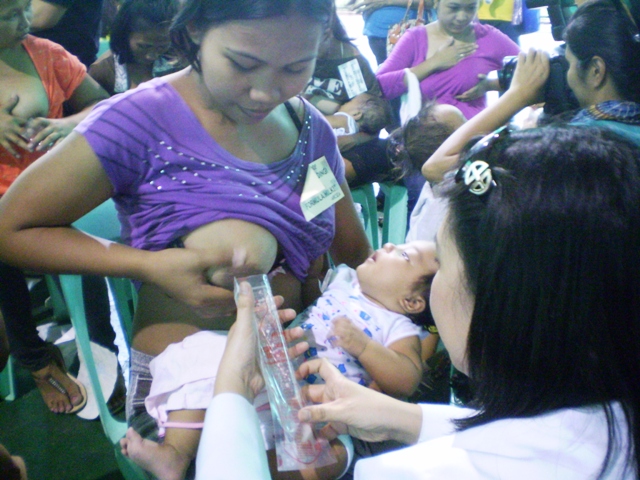
Face it, our country is disaster prone. And relief work is something that has really sparked my interest because of the sheer need and urgency. This has taken a whole new meaning with my new understanding of breastfeeding and its implications for infants in disaster areas. Most health workers have little knowledge of breastfeeding and lactation management during crisis. I have read the theories and the expert recommendations, but I haven’t seen them work on the ground. During the holidays, I was privileged to be with my Team UnangYakap mentors, Dr. Maria Asuncion Silvestre and Dr. Donna Isabel Capili supported by WHO Philippines (thru the United Nations Central Emergency Fund) to conduct a breastfeeding mission for Pablo victims in one of the evacuation sites. I am thrilled to report to you some realizations:
Monday, December 17, 2012
Visting Fabella Hospital and KMC
Johnsons' Baby sponsored the construction of two Touch Therapy centers where moms and their babies can stay for infant massage. While the hospital is not airconditioned, the 2 centers are, allowing moms some relief from the heat while they are massaging their babies.
Tuesday, October 2, 2012
PSA: Alay na Gatas mo. Sagip sa Buhay ko
We are pleased to inform you that the Breastfeeding TSEK (Tama, Sapat, Eksklusibo) campaign has been effective in raising mothers’ awareness on the benefits of breastfeeding in the cities of Caloocan, Malabon, Navotas and Valenzuela.
To date, our exclusive breastfeeding rate have significantly increase from 41% in 2010 to 74% in 2011in Caloocan City, 66.24% in 2010 to 82.23% in Malabon City, 49% in 2010 to 61% in Navotas City and 74.54% in 2010 to 80% in Valenzuela City. We are most grateful for ARUGAAN for training and mentoring the peer counsellors and equipping them with the necessary skills and knowledge to guide and assist pregnant moms with their babies in their breastfeeding journey.
![]() |
| Photo by Anne Marxze D. Umil/Bulatlat.com |
Our campaign does not stop here and we are in fact on our way to implementing the program on a wider scale through the conduct of a simultaneous breast milk letting activity “Alay na Gatas mo. Sagip sa Buhay ko” on October 11, 2012, Thursday to be participated by all health centers in CaMaNaVa District.
A total of at least 3,000 lactating mothers will participate in the activity that aims to advocate that infant formula is not needed during calamities, crisis and emergencies since mothers who breastfeed can donate their expressed breastmilk to infants in need. Breastmilk to be collected will be donated to the milk bank of Philippine Children's Medical Center to help premature and sick children in need of mother's milk. We are working with the local government units and breastfeeding advocates who can help with our cause.
We hope to provide tokens of appreciation to the breastfeeding mothers and breastfeeding support group members who will join the breastmilk letting activity. Special prizes will also be given to mothers who are most participative, breastfeeding icon, best breastfeeding practice barangay etc. We hope that you can support us by providing tokens and prizes for the mothers involved. A donation in cash or in kind would be highly appreciated.What is urgently needed would be breastmilk bags to store the milk that will be collected during the event. If you would like to pledge milk bags, please do contact the City Combi Officer, Kenneth Samaco at 09164632165.
Sunday, September 30, 2012
Milk Mama Diaries: Wet Nursing
Wet nursing has been in existence for several centuries. I previously wrote about a UK TV show which talked about other people's breastmilk. Locally, milk sharing is done through milk banks or mother to mother donations. And of course, we have all heard of Salma Hayek breastfeeding another baby.
Wednesday, September 26, 2012
A Mother's Commitment: Giving without Counting the Cost (a Johnson's Baby Sponsored Post)
According to the Environmental Working Group, "Johnson & Johnson is the first major personal care products manufacturer to take such an important action in favor of its customers' safety." In fact, EWG has a petition to thank Johnson & Johnson for its action.
Thursday, September 20, 2012
Join our September Milk Mama Diaries Carnival - World Milksharing Week 2012
I have previously written about donating breastmilk and its importance especially during emergencies and calamities. Milk banks are also constantly in need of donated milk to provide for the NICU babies who rely on them.
For this carnival, Mec and I are inviting mom/dad bloggers to share their thoughts/experiences on and hopes for sharing milk. The carnival is also open to families who are milk recipients and would like to share their own experiences or challenges being a milk donee. Check out my previous carnival posts to get an idea of how the blog carnival works and how posts look like. To join, please fill up the form here or below.
Monday, November 28, 2011
Responsible Milk Sharing
Donor moms are receptive to the idea of having donee-moms get the milk directly from them while moms who are looking for breastmilk usually find it difficult to get pasteurized milk from human milk banks and find the informal milk sharing network more accessible.
I was a donor to both milk banks and individual moms at the height of my milk-making career. I donated to PCMC (a representative from the bank picked it up) and UP-PGH (I had to drop off the milk) and to individual moms who pick-up the milk from my place. Honestly, I preferred to donate milk to individual moms as they do so at my own convenience e.g. they bring their own coolers and pick-up from my place. Whereas donating to UP-PGH was so cumbersome since I had to pack up the milk in the cooler, look for parking, pay for parking and bring the milk up - with their elevators usually jampacked. Although now, PGH has volunteers to pick-up the milk upon schedule. Plus, the thank you that you receive from individual moms is much more satisfying.
Friday, December 17, 2010
Milk Banks, Milk on Motorbikes and BPA-free bottles

Tuesday, November 9, 2010
Operation Foster Milk and Eats on Feets Philippines


CONTACT :
Emma Kwasnica
Eats On Feets GLOBAL
(514) 656 1560
Montreal, CANADA
http://www.facebook.com/emma.kwasnica
emma.kwasnica@gmail.com
World's Largest Breast Milk Sharing Network Spreads Across Facebook: "Eats On Feets" Goes Global
Within a matter of days, women around the world have mobilized on the social networking site Facebook to organize an international, woman-to-woman milk sharing network. Human milk is for human babies, and formula-feeding is associated with risks to both the mother and infant. Women today are aware of this fact and are taking their life-sustaining power back into their own hands --they are now converging on Facebook to freely share their breastmilk with one another.
Montreal, Canada, November 7, 2010 - The announcement last month from internet health guru, Dr. Joseph Mercola, of his plans to launch his own brand of powdered infant formula onto the US market, has spawned the Eats On Feets GLOBAL breastmilk sharing network. In retaliation against yet another needless and harmful artificial breastmilk substitute to hit the market, mothers on Facebook from around the world have come together to take a stand for infant health. They have now established the world's largest human milk sharing network, an initiative spearheaded by Canadian lactating mother and passionate breastfeeding activist, Emma Kwasnica.
The "Eats On Feets" name is the brainchild of Phoenix, AZ midwife, Shell Walker. A mother to young children in the '90s, Walker and her friends had this thought: "Hey, why don't we just become wet-nurses? Instead of 'Meals on Wheels', we can call our business 'Eats On Feets'." Walker took this idea and made it a reality in July, 2010, when she created a Facebook profile page under the same name, and began a free, community-based breastmilk sharing network for mothers in Phoenix. She has since been successful at matching up local women who have an excess, or are in need of, human breastmilk.
Meanwhile, Kwasnica has also been using her personal profile page and her large network of international birth and breastfeeding activists on Facebook, in order to match up human milk donors and recipients around the world. One such story involves a fellow Canadian friend, living in Bandung, Indonesia; the school teacher and single father to a newborn son wondered if he could source human milk for his baby instead of feeding his son a powdered breastmilk substitute. Aware of his situation, Kwasnica put the call out to her vast network via a simple status update on Facebook, and a breastfeeding peer counselor in a neighbouring city in Indonesia responded. A string of lactating women on the ground was assembled to provide human milk locally for the infant boy. Now three months old, this baby has never tasted anything other than human milk.
The announcement of Dr. Mercola's plans to market formula was the final catalyst that spurred Emma Kwasnica on to convene with Shell Walker and launch Eats On Feets GLOBAL. Regarding the inception of this initiative, she states: "Shell Walker is a friend and the midwife in Phoenix, AZ who came up with the name 'Eats On Feets'. She graciously allowed me to use her catchy name in order to launch the global initiative: a woman-to-woman, grassroots milk sharing network here on Facebook. As for Dr. Mercola, he should be injecting his burgeoning wealth into breastfeeding support, not trying to make more money off a product that is harmful to infants and their lifelong health."
With the help of nearly 200 women online from the global mothering Facebook community, the initiative has taken off. Donor and recipient milk matches are being made right now all over the world on the pages of Facebook. There are now 87 Eats On Feets chapter pages spanning 18 countries (a quick Facebook search for "Eats On Feets" yields dozens of results). This movement is proof that Facebook can, indeed, be used for the good of humanity. By encouraging the biologically normal way of feeding babies, and reviving an age-old practice of human milk sharing, it is clear that social networking has the power to revolutionize infant health.
ABOUT Eats On Feets GLOBAL - The Eats On Feets GLOBAL network chapter pages on Facebook provide an online space to facilitate woman-to-woman milk sharing. We assert that women are capable of making informed choices and of sharing human milk with one another in a safe and ethical manner. Eats On Feets GLOBAL does NOT support the selling or corporatism of human breastmilk.
For a current list of all of the Eats On Feets chapter locations in operation around the globe, or to find your local Eats On Feets Facebook chapter page, please see this document at the following URL: http://tinyurl.com/EatsOnFeetsGLOBAL
To listen to the radio show podcast (from October 30) where Emma Kwasnica discusses the events that lead to the launch of Eats On Feets GLOBAL, and how the ethics of Dr. Mercola were the catalyst for this initiative, visit: http://kopn.org/archive and click on "Momma Rap".
-###-
Update: 3/24/2011
Tuesday, October 5, 2010
Other People's Breastmilk
Kate Garraway - herself the mother of a two-year-old daughter - investigates the pros and cons of cross-feeding, breast-milk donation and wet-nursing by meeting some of the growing numbers of women who share each other's milk.
'I'm on a journey to find people who believe milk has to be from the breast,' says Kate, 'people who buy it, sell it, people who give it away and people who even feed each other's babies. To many this might seem weird, but they challenge us that it's actually much weirder to give our babies cows' milk than it is to drink milk from another woman. It's a journey I won't forget in a hurry.'
The people Kate meets include sisters who cross-feed their babies; women who are able to breast-feed even though they have never been pregnant; surrogate mothers who produce two gallons of milk a week for donation; and a cancer sufferer who believes breast milk has cured his condition.
Thursday, July 15, 2010
Brownouts and Breastmilk
Previously frozen milk that has been thawed can be kept in the refrigerator for up to 24 hours. While there is limited evidence to date that milk thawed for a few hours may be refrozen, this results in further breakdown of milk components and loss of antimicrobial activity. At this time, the accepted practice is not to refreeze thawed milk. While some mothers and caregivers reheat expressed milk that was leftover and refrigerated after a previous feeding, there is no research on the safety of this practice. There is also no research about whether freshly expressed milk left unfinished at room temperature should be discarded, or can be saved for a short time (perhaps up to one hour as reported by some mothers and caregivers) to finish the feeding if the baby wakens from having fallen asleep or still appears hungry.
Another comparison would be that of reusing previously unfinished milk. The general rule is once the breastmilk is warmed and fed to baby, any leftover milk should be thrown away. I don't *strictly* follow this rule because (1) I don't want to waste my precious breastmilk; and (2) other studies have shown that it is okay to save milk leftover from a feeding for reuse immediate at the next feeding. So what I do is, when I've thawed or warmed milk then Naima doesn't use it all up this feeding, I put it back in the refrigerator and use it again for the next feeding. If she still doesn't finish it, that's when I throw it out. I go by the taste/smell test -- I ask Naima's nanny to taste or smell the milk before giving to baby before giving it to her or deciding to throw it out.
The even better news is that, according to new findings in the journal Breastfeeding Medicine, checking breastmilk is actually a fine option. The researchers took frozen breastmilk and thawed it, refroze it, refrigerated it and left it out at room temperature. Essentially, they beat it up. What did they find? Breastmilk is fairly robust and does not grow bacteria easily nor lose vitamins A and C or free fatty acids (FFA) to any degree that would harm a full term baby. Breastmilk fresh from the breast or thawed in a clean container can be left at room temperature for less than 8 hours.
What do you do with frozen milk you pumped on your trip? Don't mess with ice. Ice is warmer than frozen milk and will actually hasten to thaw your milk —who knew? This is because water freezes at 32° F and milk freezes at around 0° F. Use frozen gel packs to keep your frozen milk frozen longer in your insulated cooler in your checked luggage. Crumple paper all around the milk and gel packs to further insulate it. The study in Breastfeeding Medicine found that even if the milk thaws, it is good to use provided it was not at room temperature for more than eight hours. If it is cool when you unpack it—it is good to go. It is also safe to be refrozen. This is important because moms think they have to use it right away if thawed and may feed it to the baby instead of actually breastfeeding as soon as they get home. Better to get baby on the breast as soon as you return home, and refreeze or refrigerate the pumped milk for the next mother-baby separation.
I read also to put an icecube in a plate inside your freezer. In case of brownout, check the ice. If the shape changed (which means that the ice cube melted then froze again). The same thing happened to your milk.
Instead of throwing it away, you can donate it to the hospital where you gave birth. Just call the nursery nurse before going so you can check if you still need to be screened or if they ll just accept it when you give your pedia's name. For ex. cardinal santos said that theyll accept my thawed out milk.
Update: 28 September 2011
Here's a quick note that Babymama Mi'Ann posted on her Facebook page during the height of Typhoon Pedring:
Tuesday, May 11, 2010
Preventing Freezer Burn on Breastmilk
Meanwhile, if your frozen milk already shows signs of freezer burn, should it already be discarded? According to Britannica Online, freezer burn occurs when "improperly package frozen foods lose small amounts of moisture during storage, resulting in surface dehydration. If you have lots of extra stored milk, I would suggest that you throw out the frozen milk bags exhibiting freezer burn. However, considering that freezer burn is really just loss of moisture and doesn't mean that the milk is spoiled, my opinion is that you can also do the taste and smell test. Thaw out your milk in the refrigerator, then smell and taste if it is sour and spoiled. If you're lucky to have a baby who is not picky (like Naima), then you wouldn't have problems giving it. But if your baby refuses it, you can either throw it out or donate it to a milk bank with a pasteurizer. Don't forget to inform the nurse that it has already been thawed out and should be pasteurized immediately!
Saturday, April 24, 2010
Enough please!
Some comments in the article are just plain irritating and ignorant but seriously, I think serving food made out of breast milk to adults is just strange. I have no qualms about serving food made out of my breast milk to my daughter or my niece. But I believe that breast milk is for babies and there are other better uses for extra milk than making breast milk cheese or breast milk cupcakes for sale! If you have extra milk, please choose to make food for YOUR baby or donate your milk instead.
Thursday, February 18, 2010
Hierarchy of Infant Feeding Choices
The vast majority of mothers can and should breastfeed, just as the vast majority of infants can and should be breastfed. Only under exceptional circumstances can a mother’s milk be considered unsuitable for her infant. For those few health situations where infants cannot, or should not, be breastfed, the choice of the best alternative – expressed breast milk from an infant’s own mother, breast milk from a healthy wet-nurse or a human-milk bank, or a breast-milk substitute fed with a cup, which is a safer method than a feeding bottle and teat – depends on individual circumstances.For infants who do not receive breast milk, feeding with a suitable breast-milk substitute – for example an infant formula prepared in accordance with applicable Codex Alimentarius standards, or a home-prepared formula with micronutrient supplements – should be demonstrated only by health workers, or other community workers if necessary, and only to the mothers and other family members who need to use it; and the information given should include adequate instructions for appropriate preparation and the health hazards of inappropriate preparation and use. Infants who are not breastfed, for whatever reason, should receive special attention from the health and social welfare system since they constitute a risk group.

Saturday, January 23, 2010
The cup of life

Human milk has no substitute. Breast milk also has immunoprotective properties that fight against life-threatening infections like sepsis, pneumonia, diarrhea, and enterocolitis. It likewise has components, which help the newborn’s intestinal tract to mature, allowing for easy digestion, better absorption, faster growth, and better health. Plus, it also has nutrients in a combination that no artificial product can duplicate.
Thursday, December 31, 2009
Milk Storage - Part II
1. Hard-sided containers, such as hard plastic or glass, are the preferred containers for long-term storage. These containers should have an airtight seal. Check here for tips on how to use glass containers for milk storage.
2. Choose containers that are bisphenol-A free --> not polycarbonate plastic.
3. Containers must have been washed in hot, soapy water and rinsed. People have been asking me if we sterilize the bottles. We don't have a sterilizer and rarely sterilize. Instead, I just pour boiling or hot water on the containers after they've been washed. We stopped doing this when Naima turned 1.